
A master plumber with no website, findable everywhere in three weeks.
Brandon Byrd is a licensed Alabama Master Plumber in Fairhope who had no website at all until August 2, 2026. The studio designed his brand from the logo up, built a 413-URL Baldwin County platform around it, and had 406 pages on Google inside three weeks — with the first customer call ~26 hours after launch.
Live 8/2/2026 (evening) · 406/413 URLs indexed by 8/25 · first website call 8/3, 3:36 PM CT · 413 URLs on the live sitemap. Indexing and call figures come from Google URL Inspection and the site's own server-stamped call ledger; the $30K figure is the owner's estimate, labeled as such.
Streamlined Plumbing is a one-truck operation with master-plumber credentials (AL MP-4462), a 4.8-star Google profile, and — until August 2026 — no website of any kind. The studio designed the identity from zero: a pipe-built S+P monogram, a mint-to-blue gradient system, and clean geometric type. Then it built the platform to wear it — 413 URLs, a 308-page city × service matrix across 22 Baldwin County communities written against real keyword data, and a verified lead ledger. A daily indexing burst put 406 of those pages on Google inside three weeks. The first customer call came ~26 hours after launch, and Brandon estimates roughly $30,000 of work booked in his first 30 days.
A mark built from a pipe,
not a template with a wrench on it.
The monogram is the whole idea in one shape: an S bent from pipe segments — flanges, joints and all — that doubles as the P of "Plumbing", carrying a mint-to-cyan-to-blue gradient that moves like water through a line. Everything else derives from it: the palette, the type, the gradient spine running through the site's UI.


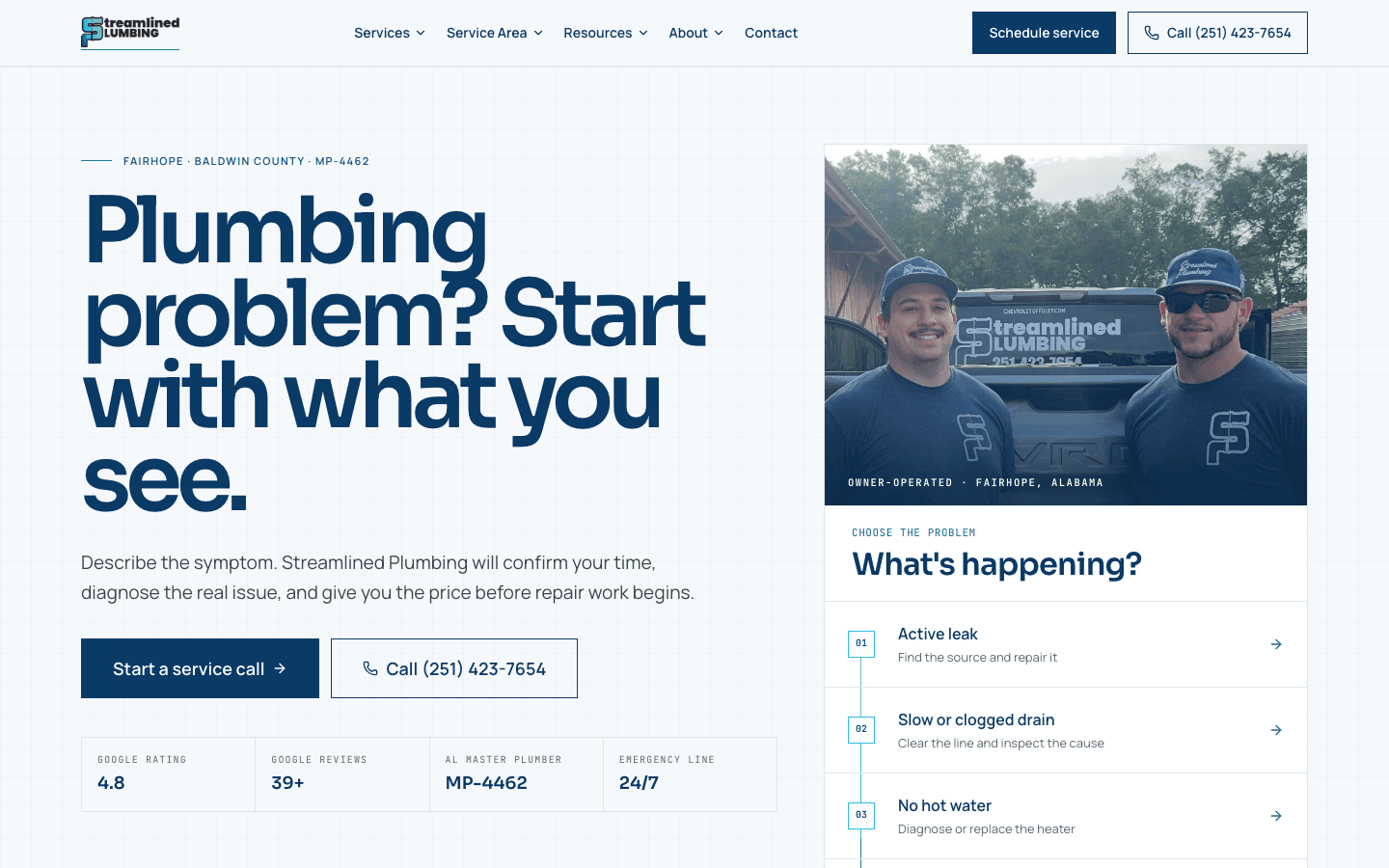
Plumbing problem?
Start with what you see.
A clean geometric grotesque chosen to literally look "streamlined". Tight tracking at display sizes, weights 600–800.
Describe the symptom. Streamlined Plumbing will confirm your time, diagnose the real issue, and give you the price before repair work begins.
Warm, legible sans carrying long-form trust content across 400+ pages.
A hero that routes,
and 413 pages with a job.
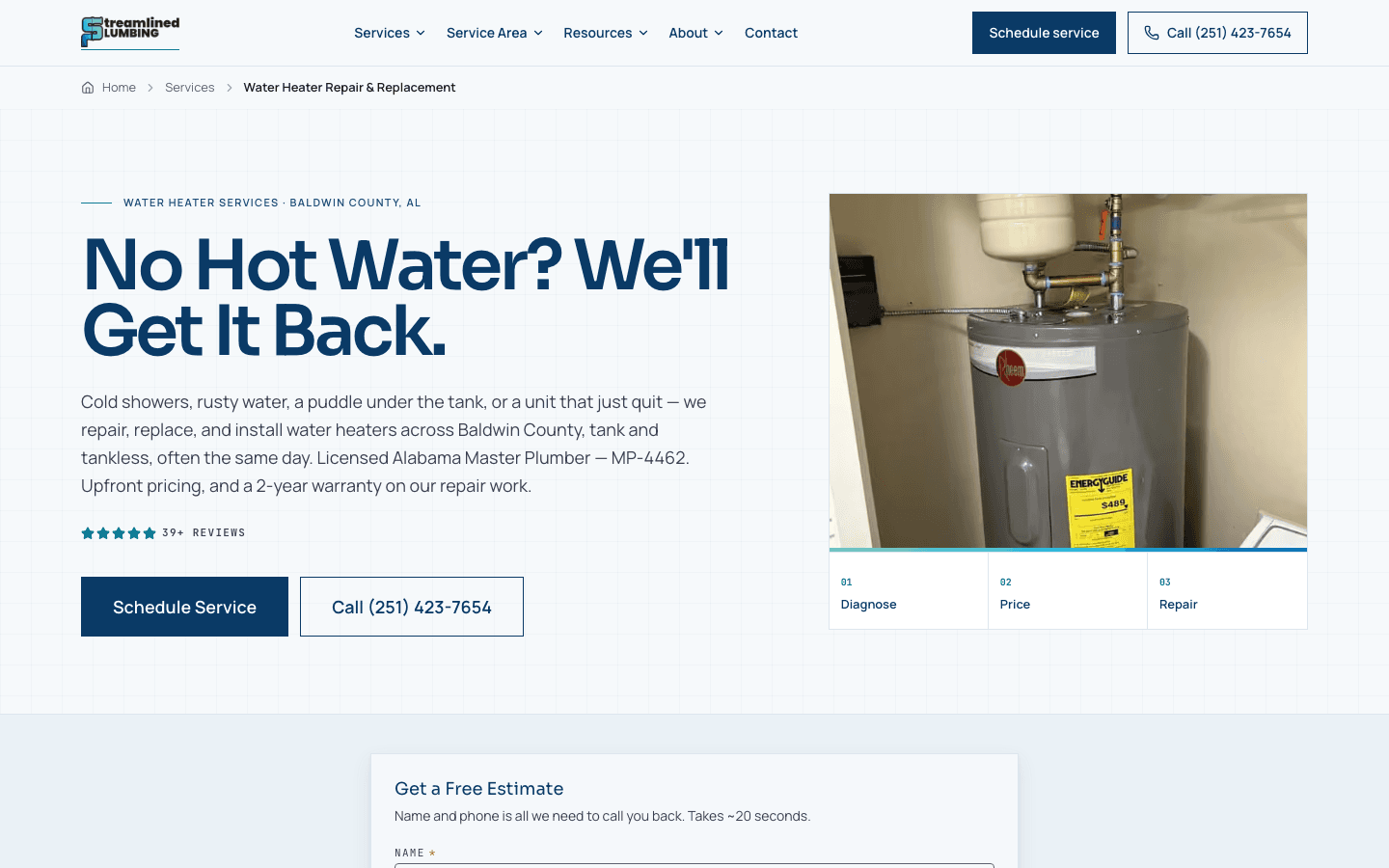
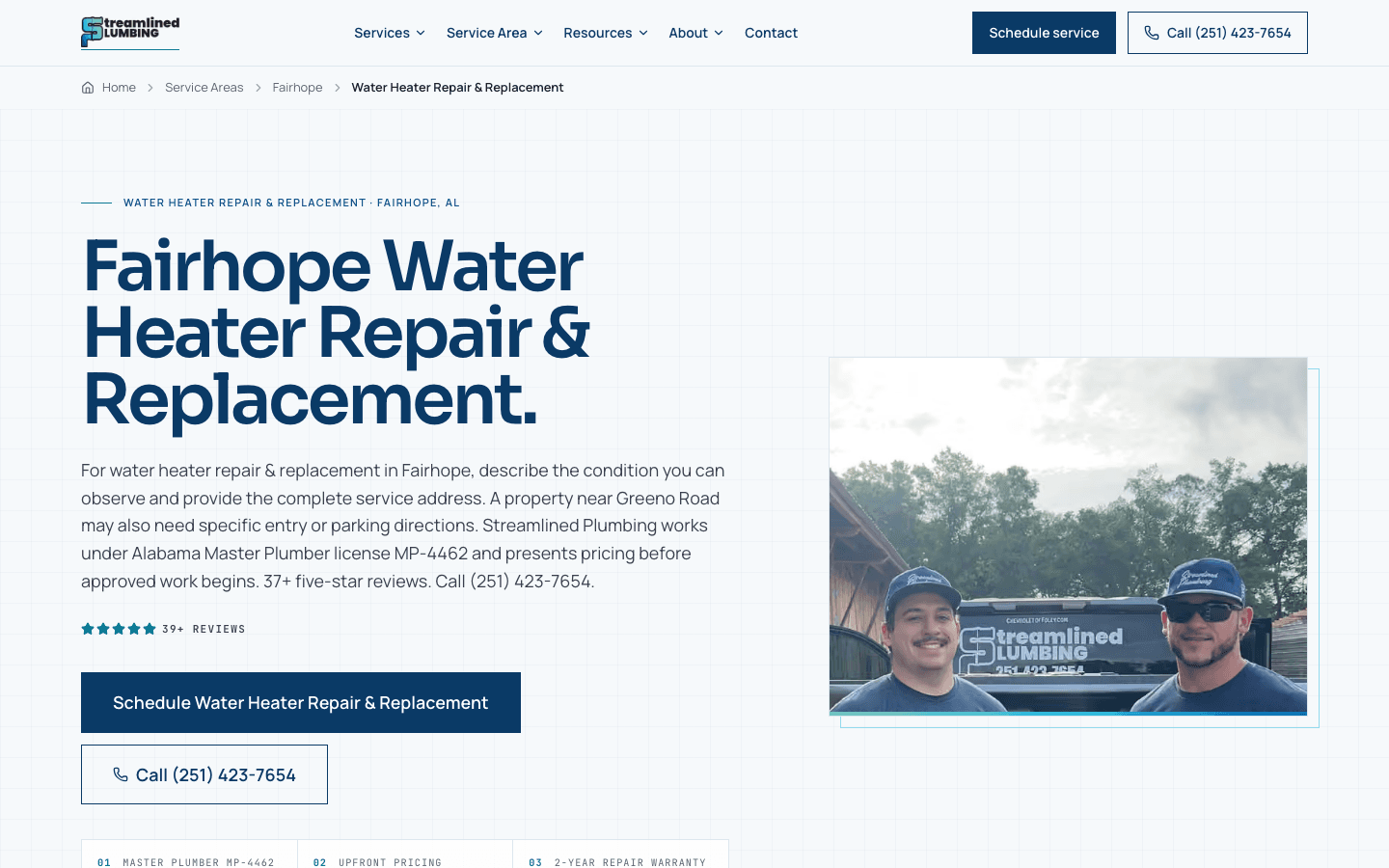
Most trade sites open with a stock photo and a slogan. Streamlined's opens with the Streamlined Route System: the visitor picks the problem they can see — active leak, clogged drain, no hot water — and the site routes them straight to diagnosis and price. One real crew photo carries the trust; the design does the selling. Underneath it, every community the truck serves gets its own findable page, each written against a 140,053-row keyword research corpus collected for this exact market.
- A complete brand system designed from zero — logo, palette, type — scaling from the website to the van to the Google profile
- A 308-page programmatic city × service matrix across 22 Baldwin County communities — individually written, no find-and-replace city swapping
- Problem-first homepage routing (the Streamlined Route System) instead of a decorative hero
- Entity-graph Schema.org on every route — LocalBusiness, Service, FAQ, Breadcrumb
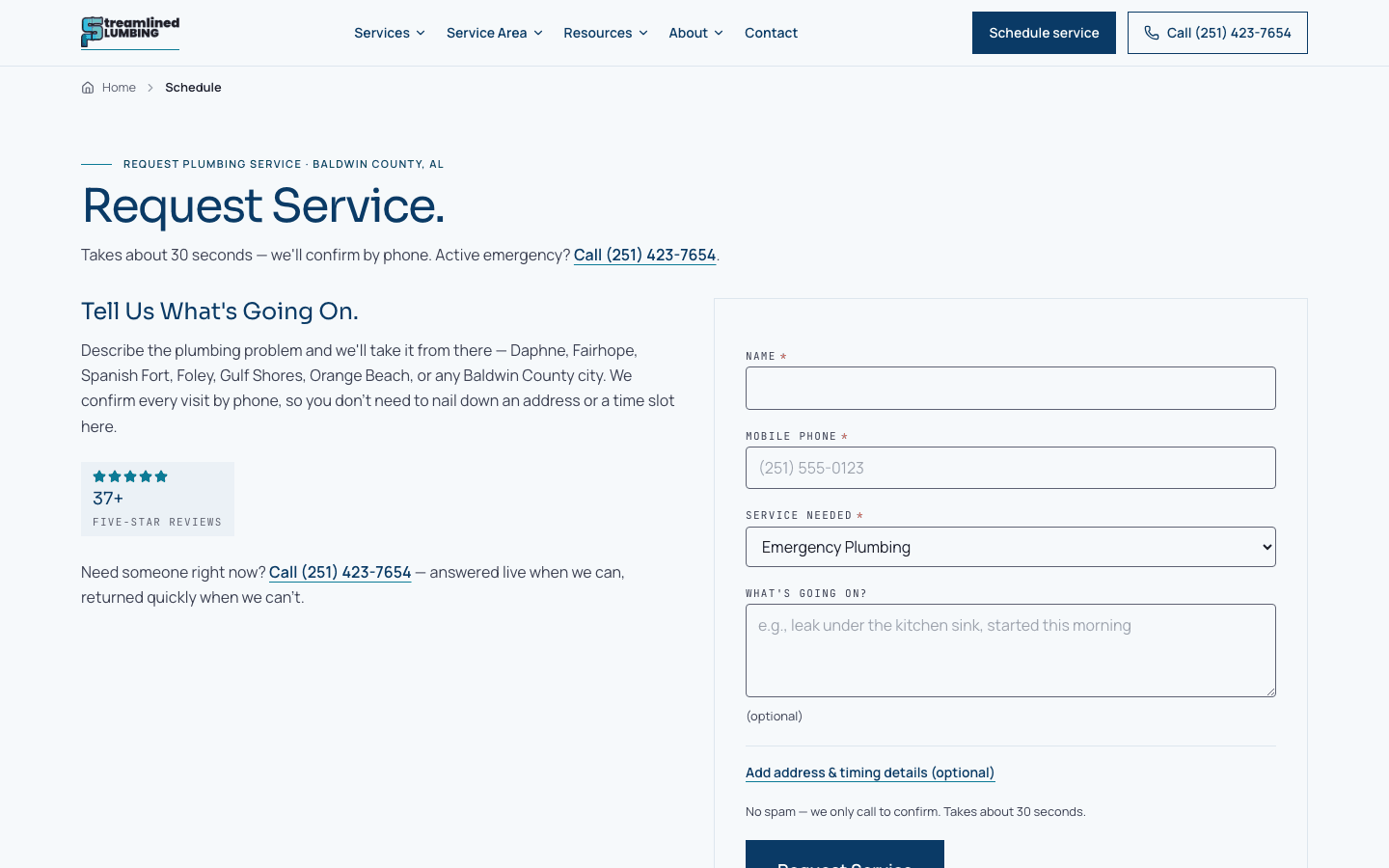
- A server-stamped lead ledger — every form and call-click logged and spam-filtered before it is ever counted
- The full measurement stack from day one — GA4, Tag Manager, Search Console, call-conversion tracking
What it looks like,
live.
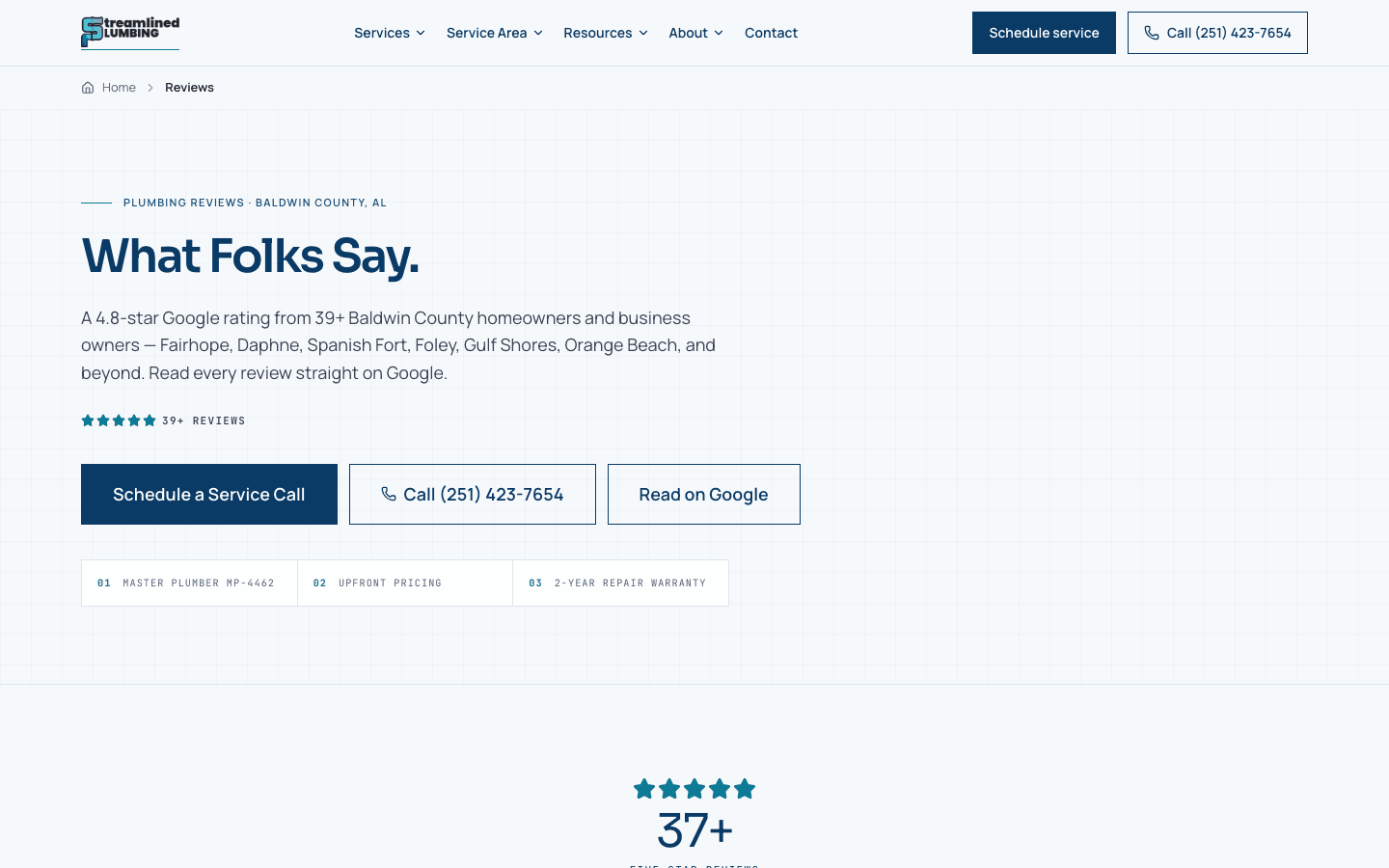
Launch week
is the campaign.
A site nobody can find is a brochure. The week Streamlined went live, the full distribution stack ran on top of it: a daily indexing burst pushing every URL to Google and IndexNow from launch night; Baldwin County search campaigns engineered from the same keyword corpus as the site itself — manual bids, exact and phrase match only, call-conversion tracking; the Google Business Profile wired to the site and tracked daily; and honest monthly lead reporting that counts only reviewed, real customer inquiries — solicitations and internal test submissions are excluded by hand before anything is claimed.
From no website
to booked.
308 city × service cells (22 cities × 14 services), 22 city hubs, 14 service pages
Live sitemap · 2026-08-04
Per matrix cell, hand-authored against a per-city data snapshot — not template-rendered
Source repo · content gate output · 2026-08-02
EPA SDWIS water system + PWSID, USGS groundwater pH, Census housing age, elevation, FEMA flood zone
Live site · matrix cells
matrix-claims, matrix-duplication, matrix-registry — duplication measured over rendered HTML, each gate self-tested
Source repo · scripts
63 coastal-specific posts authored, 11 published and the rest drip-publishing weekdays through December 2026, plus five interactive diagnostic calculators citing EPA/DOE figures
Live sitemap · 2026-08-04
GoDaddy → Next.js 301s in middleware; DNS cutover 2026-08-02
301 redirect map · 2026-08-02
Sitemap URLs indexed by Google within ~3 weeks of the Aug 2 launch
Google URL Inspection · per-URL indexing ledger · 2026-08-25
Foley homeowner tapped the header call button the afternoon after launch
Server-stamped call ledger · Aug 2026 lead report · 2026-08-03
Owner-reported estimate across all channels — the owner's number, labeled as such
Owner-reported · 2026-08-25
Brandon's estimate of roughly $30,000 in work bookedacross all channels in his first 30 days is his number, not the studio's — it is labeled owner-reported everywhere it appears. The figures the studio claims for itself are the verified ones: the indexing ledger, the call ledger, and the live sitemap. Paid visibility at plumbing's ad rates stops the day the budget does; 406 indexed pages are an asset the business keeps.
No website on August 1. The first customer call on August 3.The receipt
You should be skeptical — most marketing "results" are inflated. Every verified figure on this page traces to a ledger that can be shown on a live screen: Google URL Inspection for the indexing, the site's own server-stamped call log for the first-call claim, the live sitemap for the page counts, and the live Google profile for the review numbers. The one figure that isn't ours — the $30,000 — is the owner's report, and it is labeled that way rather than dressed up as a measurement. This build ships from the Digital Gravity team — Campbell Digital Studio and Gulf Group Software operating as one studio — with one system behind the site, the profile, and the ads.
Sources: indexing — Google URL Inspection via the studio's per-URL indexing ledger, checked 2026-08-25; first call — server-stamped site call ledger + the August 2026 verified lead report; page counts — live sitemap, 2026-08-25; reviews — live Google Business Profile, 2026-08-13 (4.8★, 39 reviews). $30K first-30-day work — owner-reported, 2026-08-25.
Want your trade
to show up like this?
Send the business name, your current site (or what's in place now), what you're trying to accomplish, and a rough timeline. Every inquiry is read personally.