
More production capacity,
without another production department.
Campbell Digital Studio becomes the production layer behind your client relationships. Next.js-first, WordPress-capable, and structured for agencies that need more delivery capacity without lowering the standard of the finished work.
You keep the client.
CDS builds the system.
Your agency keeps the sale, the strategy, and the relationship. Campbell Digital Studio takes the approved brief and handles the architecture, responsive design, development, search foundation, forms, analytics, and launch infrastructure behind it.
The finished site can carry your agency's name, a visible Powered by Campbell Digital Studio credit, or a structure between those two. Commercial terms are built around the real pipeline — volume, scope, stack, migration load, and what happens after launch — then quoted privately.
The bottleneck should be information,
not production.
With the brief, approved copy, brand assets, service areas, lead routing, platform access, and decision-maker in hand, a focused production build can reach launch-ready staging in 1–3 days. The clock starts when the information is complete — not while CDS is waiting on a client for a logo, a service list, or an approval.
Large WordPress migrations, programmatic city-and-service matrices, custom tools, and complex integrations carry more real scope. Those receive a written schedule before production. Repeat volume is planned the same way: reserved capacity, a standard intake, and review windows both sides can hold.
What starts the clock
- Approved company, service, and location information
- Final logo, fonts, colors, photography, and brand rules
- Named form recipients and the required lead-routing logic
- Domain, analytics, Search Console, and platform access
- One agency decision-maker who can approve the build
What the speed does not remove
Responsive QA, route-level metadata, schema, canonical checks, form routing, analytics, sitemap coverage, and a real deployment review still happen. The speed comes from the production system and a clean brief — not from skipping the parts a client cannot see in a mockup.
A premium build,
defined by what ships.
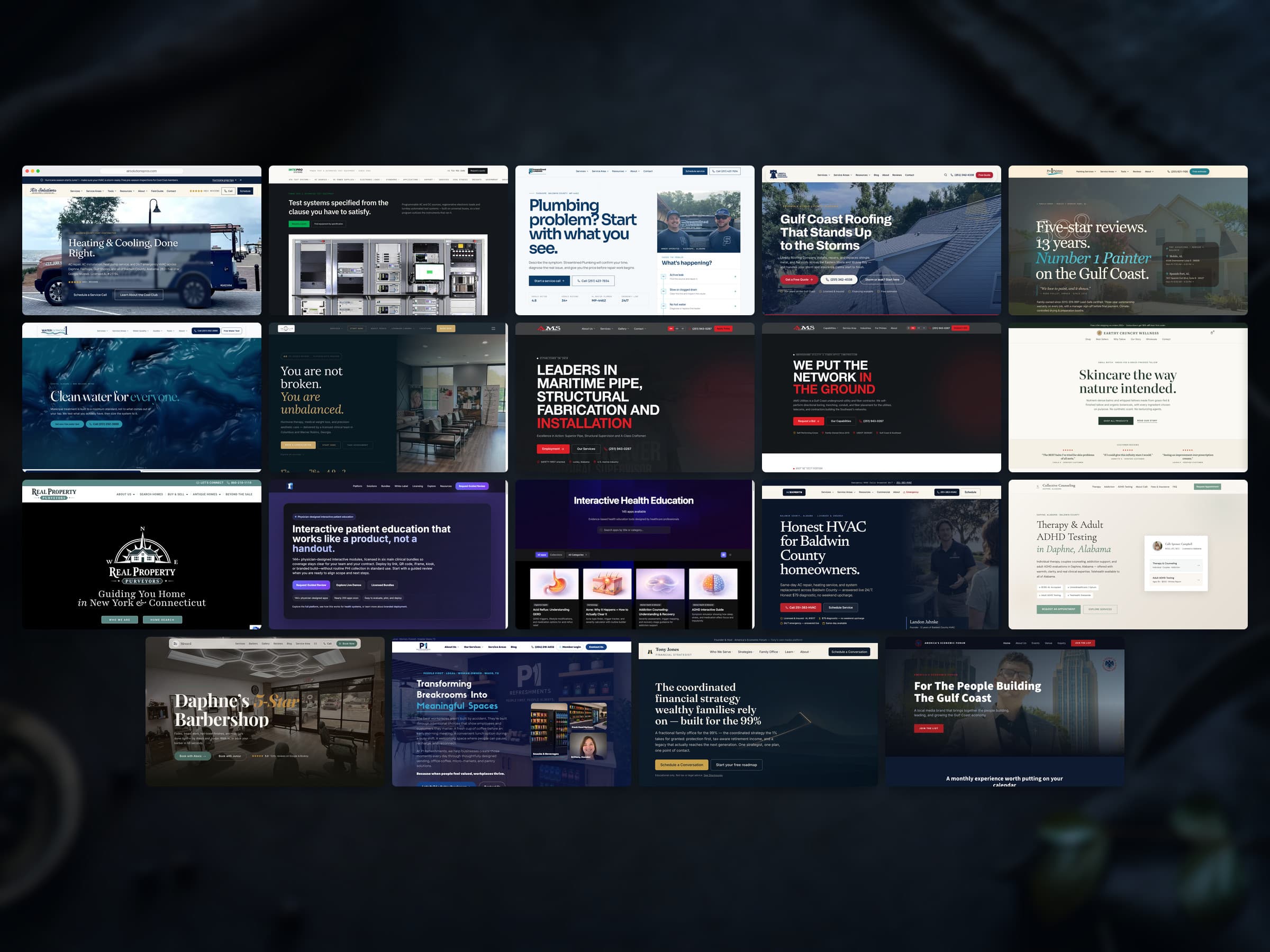
Next.js first
New builds default to Next.js, React, TypeScript, and Vercel — custom routes, clean deployment, structured data, fast page delivery, and no theme dependency between the agency and the finished work.
WordPress continuity
An agency does not have to migrate every existing client to work with CDS. Campbell Digital Studio can maintain and extend WordPress when the client wants to stay there or the economics do not justify a rebuild.
WordPress-to-Next.js migration
When the old stack is the constraint, CDS maps every live URL, preserves the content worth keeping, writes the redirect plan, rebuilds the information architecture, and moves the client without throwing away existing search equity.
Search and lead infrastructure
Programmatic service-and-location pages, schema, forms, call-click tracking, GA4, Google Search Console, and the content system behind the site. The agency gets more than a design handoff.
One operating agreement,
then a repeatable handoff.
Client ownership, communication, approval rights, branding, delivery volume, ongoing operations, and commercial terms go in writing before the first build enters production.
CDS needs the offer, sitemap or service list, service areas, approved copy, brand assets, form recipients, platform access, and one decision-maker. A clean intake is what makes fast production possible.
The agency reviews a live staging build, not a stack of disconnected mockups. Feedback happens against the real navigation, responsive layouts, forms, schema, and content architecture.
The finished site can sit under the agency's name, carry a visible Powered by Campbell Digital Studio credit, or use a structure between those two. The agreement decides it before launch.
Agencies with demand,
and a production constraint.
Brand and creative studios
Keep strategy, identity, and the client relationship in-house while CDS turns the approved system into a production website.
SEO and paid-media agencies
Add a site that can support the search or ad strategy — dedicated landing pages, conversion tracking, forms, schema, and the technical foundation the campaign expects.
Agencies with a delivery backlog
Reserve build capacity instead of hiring around a temporary spike or sending premium client work into a commodity fulfillment queue.
WordPress agencies modernizing the stack
Keep current WordPress clients supported while introducing a clean Next.js migration path for the accounts that have outgrown the old build.
Six terms that belong in the agreement
before the first build.
None of these are hypothetical. Each one is a well-known way for a working partnership to sour after months of good delivery, and each is trivially prevented by deciding it in advance. Ask any production partner these six questions — the answers say more than a portfolio does.
The fastest way to poison an agency partnership is an unplanned direct contact with the end client. Who communicates, through which address, and what happens when a client replies to the wrong thread by accident — all of it gets decided in writing before the first build enters production, not after the first awkward email.
Post-launch requests are where white-label margin quietly disappears. What counts as a covered revision, what is a new scope item, and how many review rounds are included get defined up front. The alternative is an open-ended obligation nobody priced and both sides resent.
A fast production window assumes a complete brief. A build started on partial information stalls halfway, and the stall gets attributed to production rather than to intake. That is why the intake standard is part of the agreement rather than a suggestion — it protects the agency's timeline as much as the studio's.
Two people at the agency giving contradictory feedback on the same staging build is the most common reason a schedule slips. One named approver before production starts, with the authority to sign off. Internal consensus is the agency's to manage, and it should happen before the feedback arrives.
An agency that cannot answer this question for its own client has a problem it has not discovered yet. It should be settled in the first conversation, in the agreement, and it should be settled in the agency's favor.
Sites break at inconvenient times. An agency needs to know who is reachable, how fast, and what qualifies as urgent — before the first outage rather than during it. A partnership without a named escalation route is fine right up until the moment it is not.
Nothing here is held hostage.
Leaving should be an access change.
Lock-in is the default business model in white-label web work, and it is worth being explicit about not using it. Every asset below sits in an account the agency or its client controls, which means ending the relationship costs a permissions change and nothing else.
The repository
Source code lives in a repository the agency or its client controls. No proprietary page builder, no hosted editor that only this studio can operate, no format that has to be exported to leave.
The domain and the DNS
Registered in the client's name, with the agency holding access. A vendor holding a client's domain is leverage nobody should accept, and it is the single most common form of lock-in in this industry.
Analytics and Search Console
Properties created under accounts the agency or client owns, with this studio added as a user rather than as the owner. Historical data stays behind when a relationship ends, which is the entire point.
The deployment
Hosting under the agency's or client's own account wherever the arrangement allows it. Transferring a project should be an access change, not a migration.
A useful, free way to audit an inherited build — or a prospect's current site during a pitch — is the sitemap truth checker. It reports whether a sitemap's lastmod dates reflect a real edit history or a build-time timestamp that resets on every deploy. The second case trains Google to disregard the field entirely, and it is a reliable proxy for how much care went into the rest of the build. No account, no email, and it runs against any public domain.
See the build, search foundation, shipped work, and the measurement standard.
Independent studios.
A defined production relationship.
DePinho Design is an independent Mahopac, New York creative studio and an active CDS agency partner. Joseph DePinho's public background spans graphic design and photography at the School of Visual Arts, art direction at Scholastic, senior book-cover design at Avon Books, followed by client work across web and print.
DePinho handles custom and WordPress websites, branding, logos, book covers, copywriting, photography and video, print and signage, SEO, paid search, and digital marketing. The partnership adds CDS production capacity, Next.js builds, migrations, programmatic search architecture, tracking, and lead infrastructure when a client scope calls for it.
DePinho remains independently owned and client-facing. This is a working production partnership, not a CDS-owned satellite presented as a separate agency.
Public background and service scope verified from DePinho's website on July 13, 2026.
The terms that matter
before the first client enters production.
Can Campbell Digital Studio handle repeat agency volume?
Yes. Capacity is the reason this service exists. The partnership agreement defines expected build volume, intake standards, review windows, and production scheduling so repeat work is planned instead of treated like an emergency each time.
Does every client have to move to Next.js?
No. Next.js is the preferred stack for new builds, but CDS can continue working inside WordPress when the agency or client wants to keep it. Migration is recommended when the existing platform is creating a real performance, maintenance, search, or publishing constraint.
What does the 1–3 day production window mean?
A focused build can reach launch-ready staging in 1–3 days after the complete brief, approved copy, assets, access, routing rules, and decision-maker are in place. Large migrations, programmatic page matrices, custom tools, and complex integrations receive their own written schedule.
Does the client see Campbell Digital Studio?
That is decided with the agency. The work can be fulfilled under the agency's brand, published with a Powered by Campbell Digital Studio credit, or structured between those two models.
How are white-label partnerships priced?
Privately, after CDS understands the expected volume, build scope, stack, migration load, approval process, and ongoing responsibilities. This is not a public package menu because two agency pipelines rarely create the same production obligation.
What should an agency charge its own client for this work?
That is the agency's decision and it depends on what the agency is contributing — strategy, identity, copy, the client relationship, ongoing account management. What helps is knowing what the underlying production work is worth on its own: Campbell Digital Studio publishes its direct-to-client planning anchors openly, at a $6,000 focused floor, a $12,500 planning point for the complete system, and $1,500 a month for the ongoing operation. An agency pricing partner work can reason from those numbers rather than guessing at them.
Who owns the code, the domain, and the analytics?
The agency or its client, in every case. Source lives in a repository they control, the domain is registered in the client's name, and analytics and Search Console properties are created under accounts they own with this studio added as a user. There is no proprietary builder and no export step. Transferring a project is an access change, not a migration — which is the test any agency should apply to a production partner before signing anything.
What happens if the partnership ends?
The agency keeps the sites, the code, the domains, the analytics history, and the deployments, because all of it was already in their control. There is no wind-down negotiation and nothing is held. An arrangement that requires a difficult conversation to exit was structured badly at the start, and structuring it that way would cost more in reputation than it could ever recover in retention.
Can CDS take over a site another developer built?
Usually, and the first step is an honest assessment rather than a quote. Some inherited builds are fine and need maintenance. Some are held together in ways that make every change more expensive than the last, and the responsible answer is a rebuild with the URLs preserved. The assessment covers whether the platform can publish content without a developer, whether the URL structure can support per-service and per-location pages, how it performs on a phone, and whether the sitemap is reporting real edit dates or a build timestamp.
What happens when a site breaks outside business hours?
The escalation route and what qualifies as urgent are agreed before the first launch, not improvised during the first incident. Static Next.js deployments on Vercel fail far less often than a WordPress stack with a dozen plugins, which is a large part of why new builds default there — but the answer to this question should exist in writing regardless of stack, and an agency should ask it of any production partner.
Send the pipeline,
not a generic sales-call request.
Include the number of builds you expect, the typical client scope, the current stack, who owns copy and approvals, and whether you want agency-only branding or a Powered by CDS credit. Campbell Digital Studio will reply with the structure the work actually requires.